Common Hospital Network Insurance in India: Claims Playbook
A practical guide to common hospital network insurance in India, covering cashless claims, TPA hand-offs, data validation and member-service exceptions.
Article brief
13 November 2026
13 min read
By Bharatsure Team
Category
Insurance infrastructure
Share
LinkedInQuick answer
India’s common hospital empanelment model is moving hospital onboarding towards a shared process. For insurers, brokers, TPAs and embedded-insurance partners, the operational question is not only how many hospitals are listed. It is whether hospital status, policy eligibility, pre-authorisation, documents, claim decisions and exceptions remain clear across every hand-off.
- The General Insurance Council’s Common Empanelment Platform gives hospitals a single-window route to apply to 32+ participating insurance companies, but a common MoU should not be presented as automatic cashless availability under every policy.
- A cashless journey still depends on policy eligibility, hospital status, pre-authorisation, admissibility checks, documents, non-payable items and insurer or TPA decisions.
- Partners should validate hospital identifiers, insurer participation, specialty and service availability, tariff or package rules, API status values, escalation ownership and fallback handling before launch.
- Network access is not the same as coverage. Brokers and platforms should explain that treatment remains subject to policy terms, exclusions, limits, co-payments and approval requirements.
Common hospital network insurance in India is becoming an important operating topic for insurers, brokers, TPAs and embedded-insurance partners. The General Insurance Council says its Common Empanelment Platform gives hospitals a single-window route to apply for empanelment with 32+ participating insurance companies through a common process and standardised memorandum of understanding. The Council also provides a dashboard for state, city, tier and specialty-level hospital distribution, although its public page does not state a fixed total hospital count. (General Insurance Council Common Empanelment Platform)
That distinction matters. A larger shared network can simplify discovery and reduce repeated hospital onboarding, but it does not by itself make every treatment cashless or every claim payable. The practical test is whether the partner journey can carry accurate hospital data, policy eligibility, pre-authorisation, TPA queries, documents, exceptions and insurer decisions from admission to closure.
What a common hospital network means in insurance operations
Common hospital empanelment insurance is best understood as a shared operating arrangement, not as a new category of health cover. The hospital may use one application and common documentation process to be considered by multiple participating insurers. The General Insurance Council describes the process as centralised and digital, covering the journey from application to memorandum of understanding. Participation is voluntary, and hospitals are not required to pay a registration or application fee. (General Insurance Council Common Empanelment Platform)
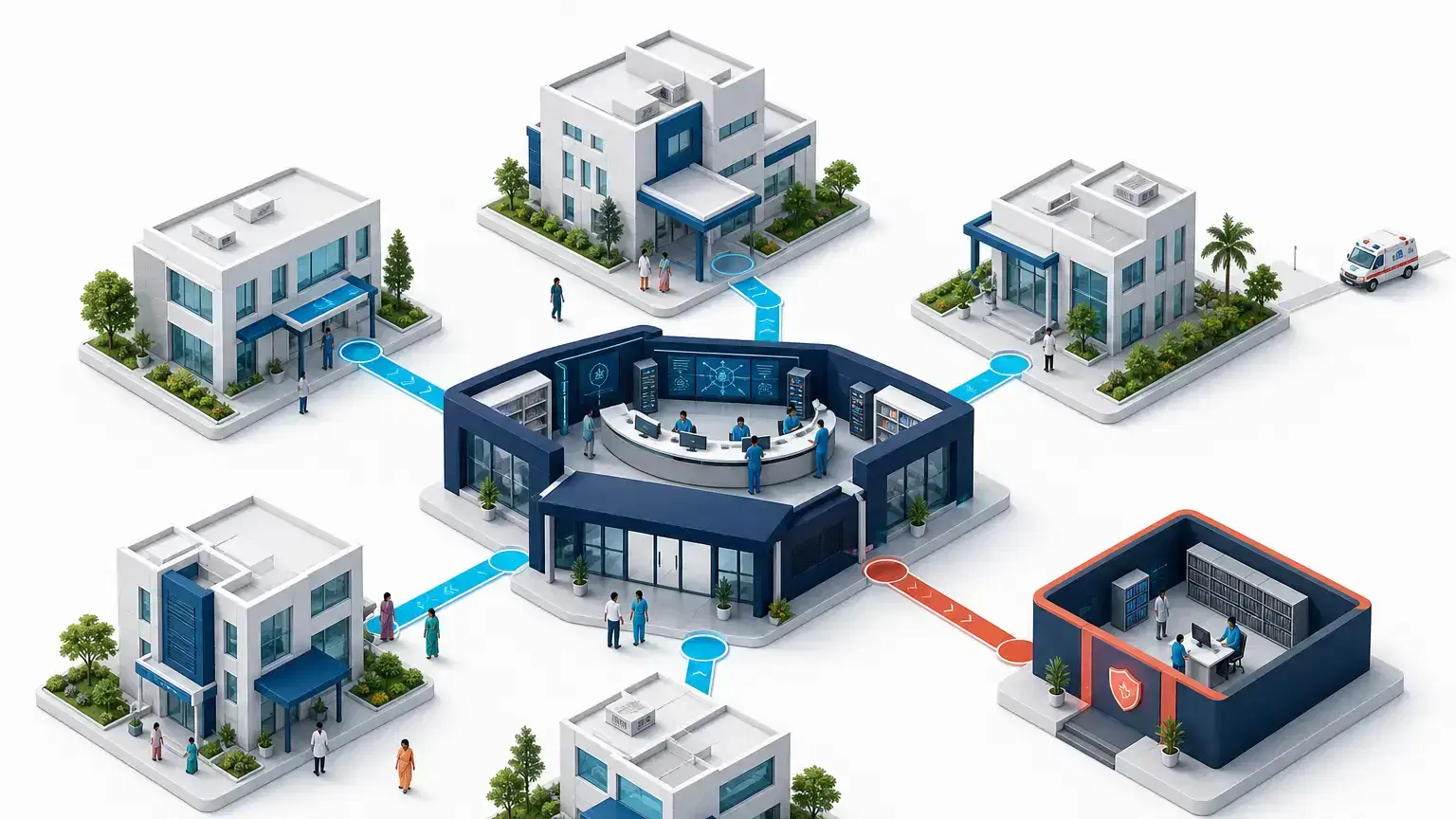
For a product or claims team, the useful distinction is between four layers:
- Common onboarding: whether the hospital has completed the relevant empanelment process.
- Insurer participation: whether a specific insurer is active in the arrangement.
- Operational availability: whether the particular hospital branch, department or treatment is currently enabled for cashless processing.
- Policy admissibility: whether the member’s policy covers the treatment after applying exclusions, waiting periods, limits, co-payments and other conditions.
A hospital directory should not be treated as a coverage engine. It should be a dated reference layer connected to policy and claims rules. The member should be able to search for a hospital, see the last refresh time, understand the available service and start a claim or pre-authorisation request without being told that network access equals approval.
How a common hospital network can change the cashless claims journey
Cashless workflows vary by insurer, policy and TPA. One United India Insurance policy document available through the IRDAI repository describes a process in which the hospital or network provider submits the cashless request, after which the TPA reviews the medical information and issues pre-authorisation after verification. The same document distinguishes a pre-authorisation decision from the member’s right to receive treatment or submit a reimbursement claim. It should be read as that policy’s process, not as a universal rule for every insurer or product. (United India Insurance policy document available through IRDAI’s repository)
A shared hospital network can change the journey in three ways.
One hospital record, several insurer relationships
A common onboarding process may reduce duplicate hospital forms and inconsistent identifiers. That can help a platform maintain one master hospital record, while still storing insurer-specific status, tariff, specialty and service fields. Do not flatten these fields into one generic “cashless available” value.
More predictable discovery
A member-facing application can offer a broader search across city, pincode, tier, specialty and treatment type. The General Insurance Council says its dashboard is designed to show state-wise and city-wise distribution, tier coverage and key specialties. (General Insurance Council Common Empanelment Platform) The product team should turn that information into practical guidance, such as whether a hospital is suitable for planned admission, emergency care, daycare treatment or a particular specialty.
New coordination points
Shared empanelment does not remove the need for insurer and TPA coordination. The platform still needs to identify who owns eligibility, who reviews medical documents, who answers a hospital query, who approves an enhancement and who closes the final bill. If those responsibilities are unclear, a larger network can increase the number of cases entering an unresolved queue.
The claims infrastructure for partner journeys should expose the claim lifecycle to the partner and member without replacing the insurer or TPA’s decision-making role. A useful journey includes intimation, document upload, review, query, approval or decline, final bill, settlement and closure. Each status should have an owner, timestamp and next action.
The claims data and TPA integrations partners need to validate
The phrase tpa hospital network integration often hides several different interfaces. Before launch, map the data contract for each one.
Hospital and provider data
Validate the legal hospital name, branch address, pincode, hospital identifier, bed or facility type, active specialties, daycare capability, emergency availability, contact details and last-updated timestamp. Preserve the source and version of the record. A common network may standardise onboarding, but branch-level accuracy remains the responsibility of the operating workflow.
Member and policy eligibility
The eligibility request should carry the policy number or member identifier, insured person details, product or plan, coverage dates, sum insured where permitted, available balance, relationship and relevant endorsements. For group policies, also check whether a recent addition, deletion or correction has been confirmed. The group health insurance endorsement workflows should not be treated as complete merely because an employer or broker submitted the request.
Pre-authorisation and claim data
Define required fields for admission type, planned or emergency treatment, diagnosis or procedure information, estimated cost, treating doctor details, supporting reports, room category, expected length of stay and hospital contact. Make document requirements visible before submission. The integration should distinguish between a missing document, a medical query, a tariff question, an eligibility issue and a final-bill discrepancy.
Status and decision semantics
Do not use one status for every negative response. “Pending information”, “pre-authorisation declined”, “cashless not available”, “treatment not admissible”, “enhancement declined” and “reimbursement route available” lead to different member actions. Where the insurer or TPA sends a reason code, store it alongside a plain-language explanation and the next step.
Audit and reconciliation
Every request should have a unique reference, submission timestamp, receiving system, document list, response timestamp, current owner and escalation deadline. Reconcile the hospital’s final bill with the approved amount and member-paid non-payable items. The partner dashboard should show whether the case is waiting with the hospital, TPA, insurer, member or platform team.
BharatSure’s claims infrastructure for partner journeys describes insurer and TPA integrations, claim-status synchronisation, document handling, hospital and daycare lists, member dashboards and claim analytics. Those are the right categories to evaluate, but each implementation still needs insurer-specific mapping and testing before a live cashless journey is presented to members.
Where shared hospital networks can still create member-service exceptions
A common hospital network reduces one type of friction, but it does not eliminate exceptions. Prepare for these cases before launch.
The hospital is listed, but the branch is different
A hospital group name may cover several locations. The member may select a listed brand while the admission occurs at a branch with a different insurer relationship. Match on the facility identifier and complete address, not only the group name.
The hospital is active, but the treatment is not
Cashless access may depend on the specialty, procedure, daycare category, package arrangement or policy. A hospital that supports cashless admission for one service may not support the same workflow for another.
The hospital has submitted an application, but activation is incomplete
An onboarding record should not be displayed as live cashless availability until the insurer, hospital and operating systems confirm activation. The General Insurance Council’s public platform describes the process as involving application, insurer consideration and execution of a memorandum of understanding. That means onboarding is a process rather than a single directory event. (General Insurance Council Common Empanelment Platform)
A planned admission becomes an emergency
The member may enter through a hospital that was selected for planned treatment but require a different process at admission. The app should make emergency intimation and the TPA or insurer contact path easy to find.
The pre-authorisation is approved, but the final bill changes
A longer stay, a different room category, a new procedure or an enhancement request can change the approved amount. The workflow needs a fresh authorisation path and a clear explanation of what the member may need to pay.
The hospital, TPA and platform show different statuses
This is a reconciliation problem, not only a customer-support problem. Display the latest received status, the time it was received and the party responsible for the next action. If the systems disagree, route the case to a human claims operator instead of presenting a confident but unconfirmed answer.
How brokers and platforms should describe network access without overpromising cover
The safest language separates access, process and outcome.
Use:
- “Search participating hospitals for your policy.”
- “Cashless treatment is subject to policy terms and pre-authorisation.”
- “Hospital status and available services can change. Check before planned admission.”
- “Non-payable expenses, co-payments, deductibles, sub-limits and amounts above the approved limit may remain payable by the member.”
- “If cashless approval is not available, ask the insurer or TPA about the reimbursement process.”
Avoid:
- “Treatment is covered at every hospital in the network.”
- “The claim will be approved automatically.”
- “No payment is required at discharge.”
- “Every hospital in the common panel offers the same package or service.”
A broker or embedded-insurance partner should show the policy document, network search, insurer or TPA contact details, emergency instructions and claim-status path together. The employee benefits platform can support this for employer-sponsored journeys where members need access to policy records, endorsements, e-cards and claims information in one place.
Network access is also not a substitute for product disclosure. The policy remains the source for covered treatment, exclusions, waiting periods, limits and claim conditions. Where the partner has a white-label interface, the insurer’s identity, the TPA route and the platform’s service role should remain clear.
Common hospital network insurance in India: partner FAQs
Is the common empanelment model the same as a TPA network?
No. Common empanelment concerns how hospitals may be onboarded or made available across participating insurers. A TPA network is the operational arrangement through which a particular insurer or policy’s claims and health services may be administered. The member journey must check both the insurer-policy relationship and the active hospital status.
Can a platform use one hospital list for all health policies?
It should not assume that. A platform may maintain a common provider master, but the member-facing result should be filtered by insurer, product, policy, branch, service, date and current cashless arrangement. The network list is a reference input, not a universal approval decision.
What should happen if a hospital is not available for cashless treatment?
The member should receive a clear explanation and the next available route. That may include another participating hospital, a reimbursement claim process, insurer or TPA escalation, or emergency guidance. Do not label the policy as useless or the claim as declined merely because cashless access is unavailable.
What should brokers ask insurers and TPAs during implementation?
Ask for the hospital identifier format, update frequency, activation rules, pre-authorisation fields, document standards, status dictionary, response-time commitments, escalation contacts, enhancement process, final-bill process and reimbursement fallback. Also ask how the insurer handles hospital delisting or temporary suspension when a member has already received approval.
A pre-launch checklist for a cashless claims experience
Use this checklist before exposing common hospital network insurance in India through a broker, healthtech, employer or embedded-insurance channel.
Network and content
- Is every hospital record tied to a unique facility identifier?
- Are branch address, pincode, specialty, daycare and emergency fields available?
- Is the last refresh time shown to internal users and, where appropriate, members?
- Can the system distinguish onboarding, active, suspended, delisted and insurer-specific status?
- Is the network result filtered by policy and insurer?
Claims and TPA operations
- Are planned and emergency admissions handled separately?
- Does the pre-authorisation request contain all required fields and documents?
- Are query, approval, decline, enhancement and final-bill statuses mapped correctly?
- Is every hand-off assigned to a hospital, member, TPA, insurer or partner owner?
- Is reimbursement guidance available when cashless processing cannot proceed?
Member communication
- Does the interface explain that cashless treatment is subject to policy terms?
- Are non-payable expenses, limits and co-payments described without promising a zero-payment discharge?
- Can the member see the current claim status and next action?
- Are emergency instructions visible at the point of need?
- Is there a human escalation path for a mismatch between the hospital, TPA and platform?
Controls and reporting
- Are member consent, documents and communications retained with timestamps?
- Can operations teams reconcile pre-authorised amounts with final bills and settlement records?
- Are exception rates tracked by hospital, insurer, TPA, city, product and procedure?
- Are stale hospital records automatically flagged?
- Can the partner report claim turnaround, query ageing, failed integrations and unresolved member complaints?
A shared hospital network can make cashless claims infrastructure in India more consistent, but only if the data and service model are designed together. The network directory, policy engine, TPA integration, claims queue and member communications should agree on what is active, what is pending and what the member must do next. That is the difference between displaying hospital access and delivering a usable claims journey.
Book a demo to map hospital-network, TPA and claims-status workflows into a white-label insurance journey for your distribution channel.
Frequently asked questions
What is a common hospital network in health insurance?
It is a shared or standardised hospital empanelment arrangement through which hospitals can be considered for participation across multiple insurers. The General Insurance Council describes its Common Empanelment Platform as a single-window process for hospitals seeking empanelment with participating general and standalone health insurers. The hospital’s active status, the insurer’s participation and the policy terms still need to be checked before a cashless claim is presented as available.
Does a common hospital network mean cashless treatment is assured?
No. Network access is only one condition. Cashless treatment can depend on the policy, the hospital’s current status for that insurer, the treatment, pre-authorisation, available sum insured, exclusions, sub-limits, co-payment and the documents supplied. A pre-authorisation request can also require further information or be declined without deciding whether the member can receive treatment or later seek reimbursement.
What should a TPA integration show for a cashless claim?
At minimum, the integration should show member and policy eligibility, hospital and location identifiers, claim or pre-authorisation reference, request time, documents received, queries, approval or decline status, approved amount where applicable, discharge or final-bill status, settlement hand-off and the next responsible party. Status labels should be mapped to the insurer or TPA’s actual definitions rather than invented by the platform.
How should brokers describe common hospital empanelment to employers or members?
Describe it as access to a participating hospital network, not as unconditional cover. Explain how members can check the current hospital list, whether planned admission needs pre-authorisation, what to do in an emergency and which expenses may remain payable. Always add that cover is subject to the policy terms and the insurer’s claim decision.
What is the biggest operational risk in a shared hospital network?
The biggest risk is a mismatch between what the member-facing journey displays and what the insurer, TPA or hospital can process. A hospital may appear in a directory but have a different branch, specialty, service, tariff, insurer relationship or temporary cashless status. Partners need date-stamped data, clear fallbacks and human escalation for these exceptions.
Sources
- GIC-Website — gicouncil.in
- UNITED INDIA INSURANCE COMPANY LIMITED — irdai.gov.in